Saturday, October 18, 2014

Reflections on Reading

For the 3 books that I have chosen, I decided to focus on a central genre of dystopian literature, thus focusing on the thematic and ethical concerns of these 3 chosen texts.


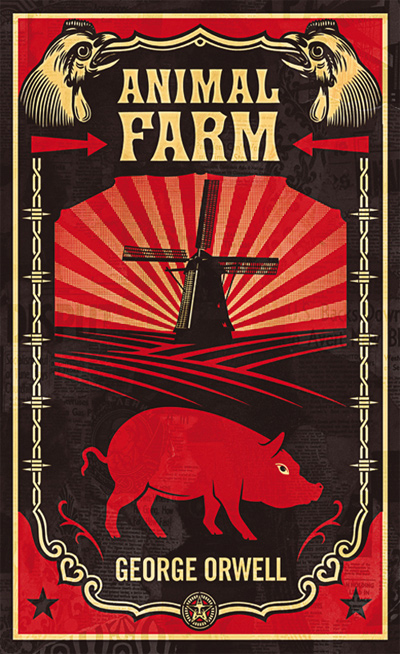
1. Animal Farm by George Orwell

The MOE text I chose is the classic Animal Farm, which is a allegorical and dystopian fable set on Manor Farm, the vision of a rural idyll. Employing a third person narrator, the story revolves around a group of farm animals who stage a revolution against their human masters. The fight for equality and freedom, however, turns out to be a facade as the pigs end up perpetuating a new tyrannical rule. This new hierarchy is more dangerous and pervasive because it is done under the guise of welfare, equality and empowerment for all.

Here, the text is highly accessible and understandable, which thus allows students to focus instead on the thematic concerns of the book - power, politics of governance, propaganda, freedom, liberation, etc. The students do this by exploring the imagery and metaphors that litter the text, allowing students to engage the text and tease out the larger connotations and implications of literary devices. A further step that could be taken, is to help students explore the cultural, political and historical context in which the text was written, in order to deconstruct its allegorical meanings.


2. The Hunger Games by Suzanne Collins

The young adult text I have selected is the hugely popular The Hunger Games, which depicts a post-apocalyptic, dystopian world where the nation of Panem is ruled by The Capitol and organized into 12 districts. The book explores the politics of control and power through the main staging of the Hunger Games event, where 1 boy and 1 girl from each of the 12 districts are selected to compete in a televised battle royale. Here, the main protagonist, Katniss Everdeen, has to struggle to protect her sister and mother by entering the Games. Teaming up with Peeta Mellark, the pair is initially seen as underdogs when compared to the more prominent and powerful districts, but they ultimately overcome the odds to win the Games together. The political implications of this victory translates into a psychological disruption of the power of The Capitol, and sets the tone for the rest of the book trilogy.

Thematically, this book works as a good exploration of dystopia, power and governance with an added spin on the familiar coming-of-age concept. The moral dilemmas, conflicting obligations, love interests and struggle for recognition are themes that are salient to the classroom audience, and serves as a good platform for them to explore based on a reader-response approach. The central theme of power and downfall is also perhaps a contemporary parallel to canonical Shakespearean texts, allowing for the same pedagogical themes while packaging it in a more relatable and engaging material. Furthermore, I think this text allows students to explore how allusion and imagery are employed, drawing parallels to Greek mythology, Roman gladiatorial events and contemporary reality television spectacles.


3. V for Vendetta by Alan Moore

For the final text, I chose instead a graphic novel which would serve to complement the array of plain text books the normal literature student will encounter. Set against the futuristic landscape of totalitarian Britain, V For Vendetta tells the story of a mild-mannered young woman named Evey who is rescued from a life-and-death situation by a masked vigilante known only as "V." Incomparably charismatic and ferociously skilled in the art of combat and deception, V ignites a revolution when he detonates two London landmarks and takes over the government-controlled airwaves, urging his fellow citizens to rise up against tyranny and oppression. As Evey uncovers the truth about V's mysterious background, she also discovers the truth about herself - and emerges as his unlikely ally in the culmination of his plot to bring freedom and justice back to a society fraught with cruelty and corruption.

Personally, I would love to teach this text, because it equally rich in its textual and imagery elements. This is perhaps different from the traditional literature text that a student encounters, and would help to broaden a student's interest in literature in a more engaging and novel manner. As with Animal Farm and The Hunger Games, V for Vendetta delves in similar dystopian themes, focusing on the power of discourse and ideas. The additional question of 'Is V a terrorist, and are his actions defensible?' perhaps raises important thematic concerns regarding terrorism and ethics. I think this graphic novel also has the advantage of having an immensely well-done screen adaptation that can be used as a study aid for students. The screen adaptation allows students to really understand the visual elements of the novel, and added layer of characterization is a bonus. But of course, eventually the students must focus on the core texts in the graphic novel and I think students will be pushed towards higher-order skills as they must negotiate the interplay of graphics and text inherent in the novel.

Sunday, October 12, 2014

Of dogs, death and mice

The Curious Incident of the Dog in the Night-Time by Mark Haddon

The story is told from the point-of-view of Christopher Boone, who is suffering from Asperger's syndrome. While the premise of the plot is Boone's decision to solve the mystery of who killed the dog, at the heart of the novel is the way Boone has to learn to navigate the world and cope with the many things that frustrate and confuse him. As things unfold, the matter is complicated when the reader realizes that there are more layers of mystery surrounding the death of his neighbour's dog, and Boone is forced to make decisions and adapt to things as they come his way. 

There are many reasons why I would definitely recommend this book as a literary text, but the most important reason being that it would really allow students to empathise with someone whom they might not usually meet, or with someone whom they might not know how to interact with. At the same time, the book explores the complexity of human relationships within the family, as well as within a small community, and often asks the reader to consider the 'rightness' or 'wrongness' of the choices that each of the characters have made. And yet, the book manages to remain accessible to the youth because of the fact that is is packaged as a mystery novel, with clear reference to Sherlock Holmes. 

At the same time, this book will also be a good point of departure to discuss adaptations, because it has been recently adapted into a play that received rave reviews at West End. (The script of the play has been published, and this can possibly be compared to the text. And perhaps in time, they might release a digital recording of the actual play itself, which would most certainly help to engage students to further discussion!)


Maus by Art Speigelman

Maus is a graphic novel that tells the story of Spiegelman interviewing his father about the latter's experience of WWII. The subject matter is heavy, and as such the choice of the graphic novel might allow the story to be more accessible for students. 

Again, this is another work that would most certainly invite discussion and allow students to consider what it would be like to live in another time, and to live in someone else's shoes. A lot of what is recounted in this graphic novels are things that many of our generation can only imagine, but will never truly know nor experience. Even so, I believe it is important to challenge students to think about the world we live in, and how we are where we are today because of what has happened in the past. 

Because of the unique format of the story, there is also a lot to uncover in terms of how children relate to their parents and the silent wall that builds up through the years. 

This graphic novel will also allow for the discussion of things like symbolism, which is rife throughout the work. The reason for choosing this is also because it serves as a good work with which to compare and contrast against the next book that I have read.


The Boy in the Striped Pyjamas by John Boyne

Told from the perspective of a young boy who is too young to be aware of events taking place in his immediate surroundings, this book is highly thought-provoking for many reasons, not least because of the fact that it deals with WWII and the holocaust. 

I haven't actually watched the movie, so I can't quite say which was better (although general sentiment seems to agree that the movie was great!) but I really liked this text. Considering that it was a long time since I'd read a YA novel, the language felt extremely simple at the beginning, even though I knew that it's intentionally so. Although, I think this might actually make the text more accessible for students. But I quickly grew to like this book, especially because of the things that it never mentions. All the important words that have become laden with baggage are somewhat censored in the book, even though readers who know exactly what happened in WWII will make the immediate connection. But this censure is important, because it is precisely due to the fact that the protagonist is never told explicitly what is happening that the story is able to reach its conclusion. 

Elsewhere, the untold stories of so many of the other characters that are briefly mentioned create a lot of room for critical discussion in the classroom. For example, how would this story have been told from the Grandmother's perspective? What about if it were told from one of the servant's perspective? 

But also, I think this book has great value because it tells the story from a very different point-of-view. Firstly, it's from the standpoint of a German, albeit only a young boy. Too often have we heard the stories of those who were persecuted, and the persecutors have been greatly demonised, but we forget that they too are humans with their own stories to tell. Furthermore, the novel possess some very difficult questions out to the readers, because it is clear that while not everyone felt happy about what was happening in Germany, there were those who did. And even though Bruno's father was responsible for killing so many jews, does he deserve to have his son taken from him just like that? And as a reader, when we feel sorry for Bruno's father (assuming that the reader does!), what sort of implications does that have on our judgement towards his actions? There's really so much to uncover and think about in this short and highly accessible text! 

So yes, I would recommend all three of the books I read because like most good literary works, they broaden the worldview of their readers by immersing us in worlds that we can barely imagine, and may not even have thought to imagine before. Plus, the subject matter is accessible and relevant to the students (make links to what the kids will be learning in history), while still allowing for discussion about literary techniques.


Reading Reflection

Ender’s Game
In a futuristic world where people live under the ever-looming threat of the destruction of the human race by the alien species known as ‘buggers’, children are selected and trained in tactical warfare in preparation for the battle for humanity. Ender Wiggins, a third-born son in the world where childbirth is highly regulated, is unknowingly the pawn of the International Fleet’s machinations (IF) that has socially engineered Ender’s life to turn him into the brutally efficient tactician that they need in the Final Battle. Ender’s training, which plunges him into depression as he is horrified by how violent and ruthless he is becoming, ends with the final plot twist – the simulated battle sessions have actually been real, and Ender has inadvertently committed genocide when he destroyed the buggers’ home planet in his ‘final test.’ Upon learning of this, Ender turns his back on humanity, refusing to return to Earth in order to find a way to revive the species which is revealed to be highly sentient and social, much like human beings.
Lord of the Flies
Lord of the Flies depicts the lives of a group of British schoolboys who are stranded on a deserted island after a plane crash. Initially democratic and determined to have “fun” while surviving being trapped on the island, the novel graphically demonstrates the boys’ descent to tribal and barbaric violence, with the brutal killing and torture of one of their own. Upon being rescued at the end of the novel, the boys, who have become savage-like, cry and lament the end of innocence.


Hexwood
In the small village of Hexwood, a girl named Ann notices strange events taking place in the farm estate – people are observed entering the building, but no one leaves. Intrigued, Ann explores the woods behind the farm estate only to discover an entirely different world in the woods. She meets an old man named Mordion Agenos whom she saw entering the farm estate a few days earlier, yet he claims that he has been asleep for centuries. In a strange twist of events, Mordion creates a little boy, called Hume, from a mixture of his own and Ann’s blood and they run into a run-down android called Yam. Still in the bizarre world in Hexwood, the group finds themselves threatened by the politicking of mythological figures – Orm Pender the Dragon, King Ambitas, Morgan La Trey and Sir Fors. The medieval fantasy-esque narrative draws to a close with the conventional slaying of the dragon, yet the text throws another plot twist – the entire Hexwood village and the woods have had its reality warped and constructed by Yam, which turns out to be a sentient cyborg designed to build such scenarios to choose the next five Reigners, people who will rule the Galaxy in a fair and just manner. Continuing with the mythological thread, Hume turns out to be Merlin and Ann’s supposedly mundane brother saved the day when he slayed Orm Pender.


For my choice of texts, I’m torn between Ender’s Game and Hexwood because of the varyingly rich possibilities the two texts offer. Hexwood is tempting because the text’s playful treatment of mythological figures would help make mythology, a common trope in canonical English Literature, more accessible to students. However, I would go with Ender’s Game as it provides the platform for the discussion on ethics and what it means to be human, since it poignantly depicts the plight of the annihilated alien ‘Other’ through the lens of their destroyer. Arguably, such issues can be discussed using most postcolonial texts. However, the defamiliarised setting and the extremity of the destruction of the Other, coupled with the fact that the narrative is told from the perspective of a child, would help situate the text within the students’ realm, making the issues more immediately relatable to the students.

Saturday, October 11, 2014

3 books - Jayne


The Fault in Our Stars is an extremely popular book amongst teens. During the time I was contract teaching, the book had made several rounds of the different classes I teach, and is often quoted atop the faded sepia photographs my students post on Instagram and Tumblr. Having read the novel, I see why it appeals to them: mopey teens completely and utterly in love with each other, though with a sinister “til-death-do-us-part” hanging over them. The protagonists both have cancer, and help each other through their struggles. However, I did not particularly enjoy the book even though I had set out with the intention to. John Green’s writing, I feel, is far too presumptuous and cloying, as though he had set out to (and in fact has succeeded in) have legions of teenagers quoting single lines of his stuff on social media. Furthermore, the events that unfold in the story are simply unrealistic, like a perfect soap opera. Even though it deals with issues of love, illness, and death, they are not dealt with completely satisfactorily, and the illnesses only serve to put pressure on the love relationship. That is why I would not recommend this book for study in a literature classroom.


The MOE recommended text I have chosen is The Boy in the Striped Pyjamas. I taught this novel to my three Secondary One Literature classes during my contract teaching. It is a simple enough read, even the lower-achieving students had no trouble reading through it and understanding the plot. It still was a challenge to get them to read deeply enough to understand the themes. The story is told mostly from the point of view of Bruno, a nine-year-old boy who makes friends with a Jewish boy his age, across the fence of a concentration camp near his home. I really enjoyed the movie that was adapted from this novel as I had a good, cathartic cry at the ending. I would have to say that it did take quite some effort on my part to make the issues and themes explored in the book relevant to my mostly Singaporean students who did not have much prior knowledge of the second World War, but I thought it made a good introduction for them to what some of the effects of the War were on a micro-level. Although I personally disliked the overly simplistic language that John Boyne used to designate the thoughts as coming from a nine-year-old, it was very moving and deals sharply with different perspectives that were taken by the various groups of people who were directly involved in the War. This book does serve one of the most important aims of Literature study: to tune students to an awareness of the Other, so I would recommend this text for lower achieving students, but push high achieving students to study texts that have more depth in the language.


A book I may not typically read is Fasting, Feasting, but once I started reading it, I could not put it down. I enjoyed reading through the perspective of an unmarriageable Indian woman, whom Anita Desai crafted very vividly. Uma is an unwed, quirky, but kind woman who lives with her parents, and her brother Arun is lonely in America where he attends university. The story sensitized me to life as a woman other than that of my own privileged circumstances as an educated Singaporean. This is definitely a book appropriate for O level Literature students to read, with plenty to learn not just about gender roles, but also race in the second part of the book.  


Reading books when there are many assignments due is an undeserved pleasure – but a pleasure, for sure. I realise, belatedly, that the two books (besides the MOE recommended text) have supernatural themes. I don't like the horror genre generally -- The Graveyard Book is the most i can take.


Nineteen Eighty-Four by George Orwell (MOE-recommended text)


George Orwell writes about a totalitarian dystopian world governed by an enigmatic all-powerful figure, Big Brother, and the Inner Party, who holds unrivalled and unquestioned power over the lives of the people. This is achieved through tight control over daily provisions and communications, and constant government surveillance. The people are kept in lack of a particular necessity, are kept isolated from each other even when they are together, and are meticulously scrutinized for an errant deed or thought. They are thus marshalled into absolute and unyielding obedience and love to Big Brother. 

Winston Smith, an Outer Party member, finds himself alone in a world, in which there is no love between friends or family, and in which memories have no lasting place and facts have no roots (and can change at the Party’s dictation). His job is to rewrite history according to what the Party says, but he tries to hold on to the truth by anchoring himself to the past. Slowly, Winston becomes aware of a girl Julia in encounters he considers more than coincidental, and soon finds out that she too engages in unorthodox activity in secrecy. They have several more meetings in rebellion of the Party, and promise to love each other, so that the Party is powerless to overcome human emotion and relationship. However, the Party eventually finds them out and tortures them with their greatest fear into betraying and hating each other. The novel paints a bleak future of humanity when Winston (and Julia) ultimately yield to the Party’s dominance and, forsaking who they are, are conditioned into loving Big Brother wholly, unreservedly and orthodoxly (is there such a word?). 


Twilight by Stephenie Meyer (Young Adult novel)


A teenage girl moves into a small quiet town in the Washington state where she is to live with her father. At her new school, she makes new friends and meets a family of siblings who appear out-of-place among the students. She soon becomes friends with the enigmatic Edward Cullen, and even though she knows implicitly that he is dangerous, they are attracted to each other. After a series of bizarre inexplicable (by any human means) events, she discovers that he and his family are vampires (who do not feed on humans), but she is willing and determined to see through her new relationship. 

Things take a turn for the worse when new and more dangerous vampires visit the area and she becomes a target for one of them. Edward eventually saves her from the threat, but not before she was bitten and infected by vampire venom. 

Suitability as an O-Level set text:
This novel is often scorned by hardy literary students as light (high-school) romantic fluff that has no real literary merit, and has been fodder for parody in film and popular culture. But the series is certainly popular among pre-teens and teenagers, and girls mostly, and so if its popularity can be harnessed to lead students to discussion about what it means to be human, this book would prove to be useful. Besides that, there are stronger reasons against its suitability as an O-Level set text, rather than for it.

I am not entirely sure that this book is suitable as an O-Level set text, because (maybe I’m not seeing) it does not seem to discuss in much depth the bigger issues of humanity and non-humanity (the supernatural) or even relationships; and appears to be written as a mental diary of a girl’s relationship with a seemingly “ideal”—but dangerous—boy, rather than a crafted text waiting for its readers to unravel the connections and admire the author’s art in constructing them, content and language. 

Of course, this novel can be analysed anyway, especially by fans of the series. One could always discuss what is it about Edward Cullen that appeal to so many girls, or the language or other literary techniques which Meyer uses to express Bella’s emotions or evoke emotions in the reader. Still, such discussion may still be more possible as a lead-in to another text that discusses more deeply humanity/the supernatural/relationships. 

 
The Graveyard Book by Neil Gaiman (A most unusual book)


‘…And for that reason, if for no other, it is vital that the child be raised with as little disruption as possible to the, if you’ll forgive the expression, the life of the graveyard.’ (p.24)

Nobody Owens (Bod, short form), is brought up in a graveyard by its inhabitants, after a man named Jack tried to kill his whole family and failed to kill him. He is accepted into the graveyard community by the Dead who care for him until he is old enough to face the dangers (and adventures of the world). At the graveyard, he learns the ways of the Dead (e.g. how to Fade from sight) and discovers the supernatural world that goes on unnoticed by the Living. As he grows up, he slowly realises the stark differences between the Dead and the Living, and longs to go out and be with living people. His guardian, Silas, disapproves of his wish, but grants it anyway. Bod soon finds out that the Living world is not all he has envisioned it to be – and the man Jack is still out there hunting him. The novel shows how Bod navigates the Dead and the Living world to keep his life safe from the man Jack and the other Jacks of All Trades who want to harm him, and how he eventually grows up and leaves the graveyard to live with the Living.

Suitability as an O-Level set text: 
Although this may be considered horror by certain criteria, the themes of humanity, of Life and Death and their attending concerns are certainly not out of the reach of Upper Sec students, if their teachers are brave enough to broach them. 

This book twists the usual ghost story in which ghosts inhabit the living’s spaces, and has a live being living among the dead. Gaiman’s portrayal of living among the dead is especially notable, as he presents what is scary, unnatural and discomfiting to us (death, the graveyard and ghosts) as completely ordinary (which it is) to the dead: tombstones are comfortable living spaces and the ‘actions’ (Fading, Dreamwalking, Sliding etc.) that ghosts do in their plane of existence just as humans walk, run and jump. In addition, there is another way of think about what it means to Live, besides its binary opposite Death. Silas, who is neither alive nor dead, is left out of many activities that Life and inadvertently Death allows. Students are given the chance here to consider more than the binary pair of Life and Death, and what that means for Life and Death. 

Furthermore, the foreboding, eerie and suspenseful atmosphere of the text provides many opportunities for a rich analysis of the literary techniques used by Gaiman not only to create but also to sustain the mood throughout. This is in addition to the word play (names: Miss Lupescu and Jack of All Trades and the names of the ghouls(?)) and choice of words.